
Overview
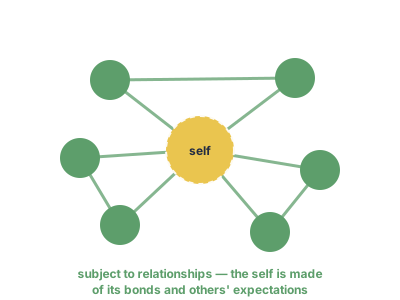
The Socialized Mind is the great achievement of adolescence and the home base of most adult lives. Its defining capacity is internalization: other people’s points of view are no longer external facts to negotiate around (as at Stage 2) but living voices inside the self. You can feel a friend’s disappointment from the inside, honor a commitment when no one is checking, and subordinate your own wants to a relationship, a team, a faith, a profession.
Everything humane about civilization leans on this structure. The Socialized Mind keeps promises, absorbs traditions, builds trust, and holds communities together. Most institutions quietly assume it, and Kegan’s research suggested that a majority of adults make meaning here or in the long transition out of it.
The cost is hidden in the gift. Because the self is composed of its relationships and internalized expectations, it cannot stand apart from them. When important voices disagree — parent and partner, church and workplace — there is no independent place to stand and adjudicate. The self is torn in two. Criticism doesn’t land on an opinion, it lands on the self. And the question “but what do you want?” can be genuinely unanswerable, because the machinery that would generate an answer independent of others has not yet formed.
Subject — what it is
Relationships, internalized expectations, shared values. The self cannot evaluate them, because it is assembled from them.
Object — what it has
Its own needs, interests, and desires which are now visible and subordinable to something larger.
What it looks like
- Conflict between loved ones’ expectations is experienced as being pulled apart, not as a decision to make.
- Criticism of one’s ideas feels like rejection of one’s person.
- Authority and orthodoxy are located outside the self e.g. in the mentor, the tradition, the manual, the group.
- Genuine devotion and loyalty, of a kind Stage 2 cannot fake, with difficulty saying no to one’s own community.
Stage 3 as a pattern
As pattern language, “3-patterned” is probably the most-used number of all. A meeting where everyone watches the boss’s face before offering an opinion is running a 3 pattern. So is consensus-seeking on a happy team, and so is the warm conformity of a holiday dinner. None of this tells you anyone’s developmental stage, because a roomful of native 4s can go “full 3” for an afternoon, and choosing to harmonize is often exactly right. The pattern is the shape of the behavior, not the native stage of the person.
The move beyond
The transition out of Stage 3 usually begins when the held expectations collide hard enough that being torn stops working as a way of life. Slowly (it takes years), the relationships and inherited values migrate from subject to object: still loved, still honored, but now evaluated by something behind them. That something is a value system of one’s own authorship: Stage 4, the Self-Authoring Mind. The transition tends to feel like betrayal and self-loss before it feels like freedom.